01
Residential Clearing Landing Page
A landing page designed as the first touchpoint for an early-stage residential services brand. The focus was on building trust, clarity, and perceived quality to support brand validation and encourage initial contact.
Client:
Residential Clearing
Role:
Product Designer
Team:
Front-end Developer
Duration:
1 Week
Overview
Residential services involve a high level of trust. Users are not just choosing a service — they are allowing someone into their home.
The main challenge was designing a landing page that could:
Build confidence without relying on metrics or social proof
Clearly communicate a broad service offering without overwhelming the user
Feel professional and reliable while remaining approachable
Serve as a validation tool for an early-stage brand
All of this needed to happen within a limited scope and without modifying certain pre-defined components.
The Challenge
Residential services involve a high level of trust. Users are not just choosing a service — they are allowing someone into their home.
The main challenge was designing a landing page that could:
Build confidence without relying on metrics or social proof
Clearly communicate a broad service offering without overwhelming the user
Feel professional and reliable while remaining approachable
Serve as a validation tool for an early-stage brand
All of this needed to happen within a limited scope and without modifying certain pre-defined components.
My Role
UX & UI Design
Information hierarchy
Content and messaging strategy
Visual system for an early-stage brand
I worked end-to-end on the landing, from structure and content decisions to visual execution.
Constraints and Context
No existing metrics or performance data
No user research or interviews at this stage
A predefined services grid component that could not be structurally modified
The client required specific services to be mentioned explicitly
The landing’s main purpose was brand validation, not immediate optimization
Rather than seeing these as blockers, they shaped the design decisions and trade-offs throughout the project.
Design approach
Designing for trust first
Without quantitative proof points, the design relied on qualitative signals of trust:
Calm, balanced layouts
Clear visual hierarchy
Neutral, confident tone of voice
Avoidance of exaggerated claims or promotional language
Every decision aimed to reduce user anxiety and make the experience feel reliable and intentional.
Managing service complexity
The brand offers multiple residential services, but listing everything at the same visual level risked clutter and cognitive overload.
Different approaches were explored:
Expanding the main services grid
Adding secondary services with equal visual weight
Introducing a subtle, contextual mention of additional services
The final solution prioritized clarity: core services remained primary, while additional offerings were acknowledged in a secondary, low-noise way. This maintained hierarchy while still fulfilling business requirements.
Replacing metrics with value signals
Since no measurable data was available, the hero section could not rely on numbers or performance claims.
Instead, the content focused on:
Commitment
Service quality
Professionalism
Attention to detail
This allowed the landing to communicate value without undermining credibility.
Design approach
Designing for trust first
Without quantitative proof points, the design relied on qualitative signals of trust:
Calm, balanced layouts
Clear visual hierarchy
Neutral, confident tone of voice
Avoidance of exaggerated claims or promotional language
Every decision aimed to reduce user anxiety and make the experience feel reliable and intentional.
Result
The result was a focused, confident landing page that positions the brand as reliable and professional, while clearly communicating its service offering.
More importantly, it established a strong foundation for future iterations, testing, and optimization as the brand evolves.
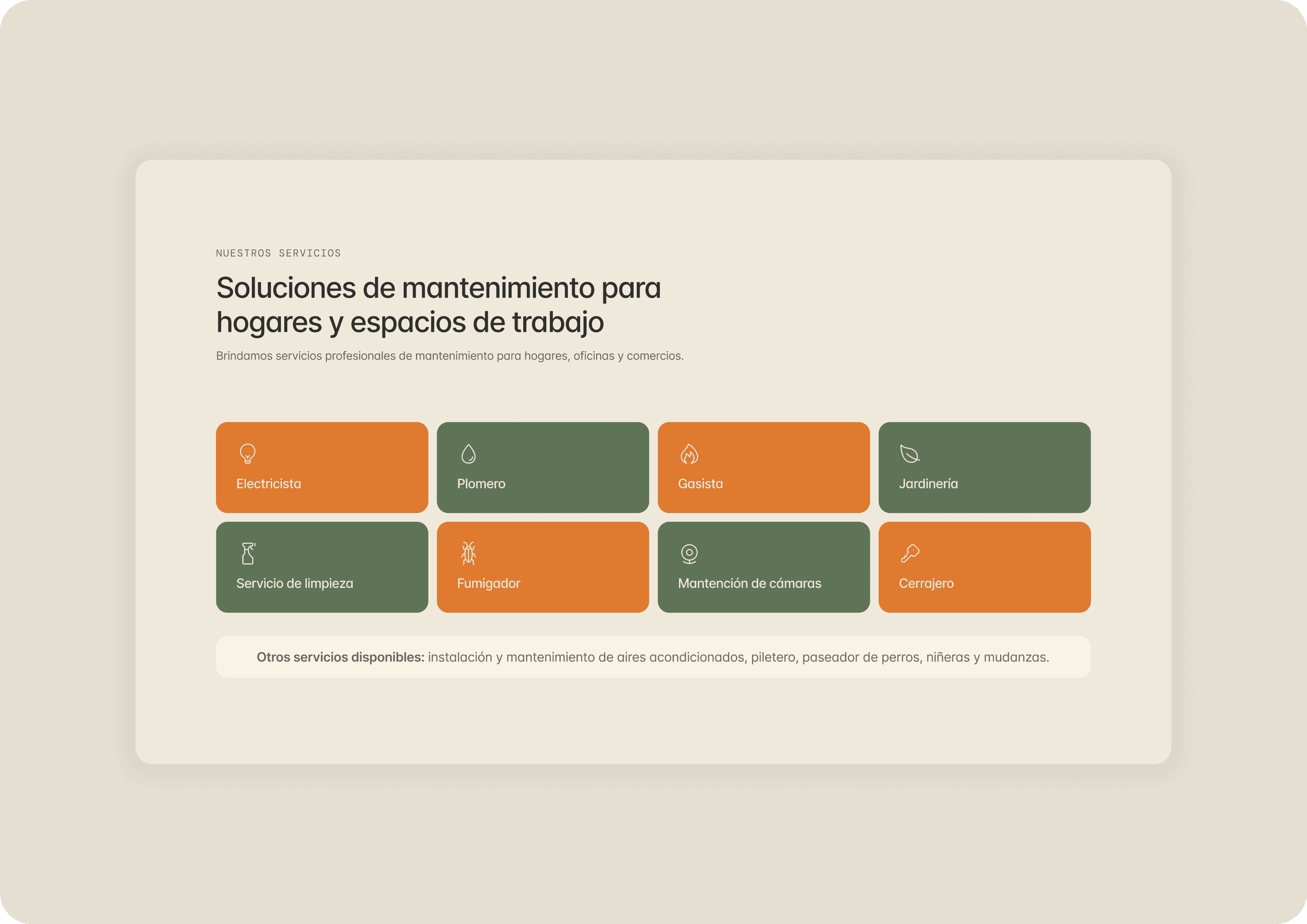
A clear overview of the brand’s main services, designed to communicate scope without overwhelming the user. Primary services are prioritized, while secondary ones are mentioned in a subtle way to preserve clarity and hierarchy.
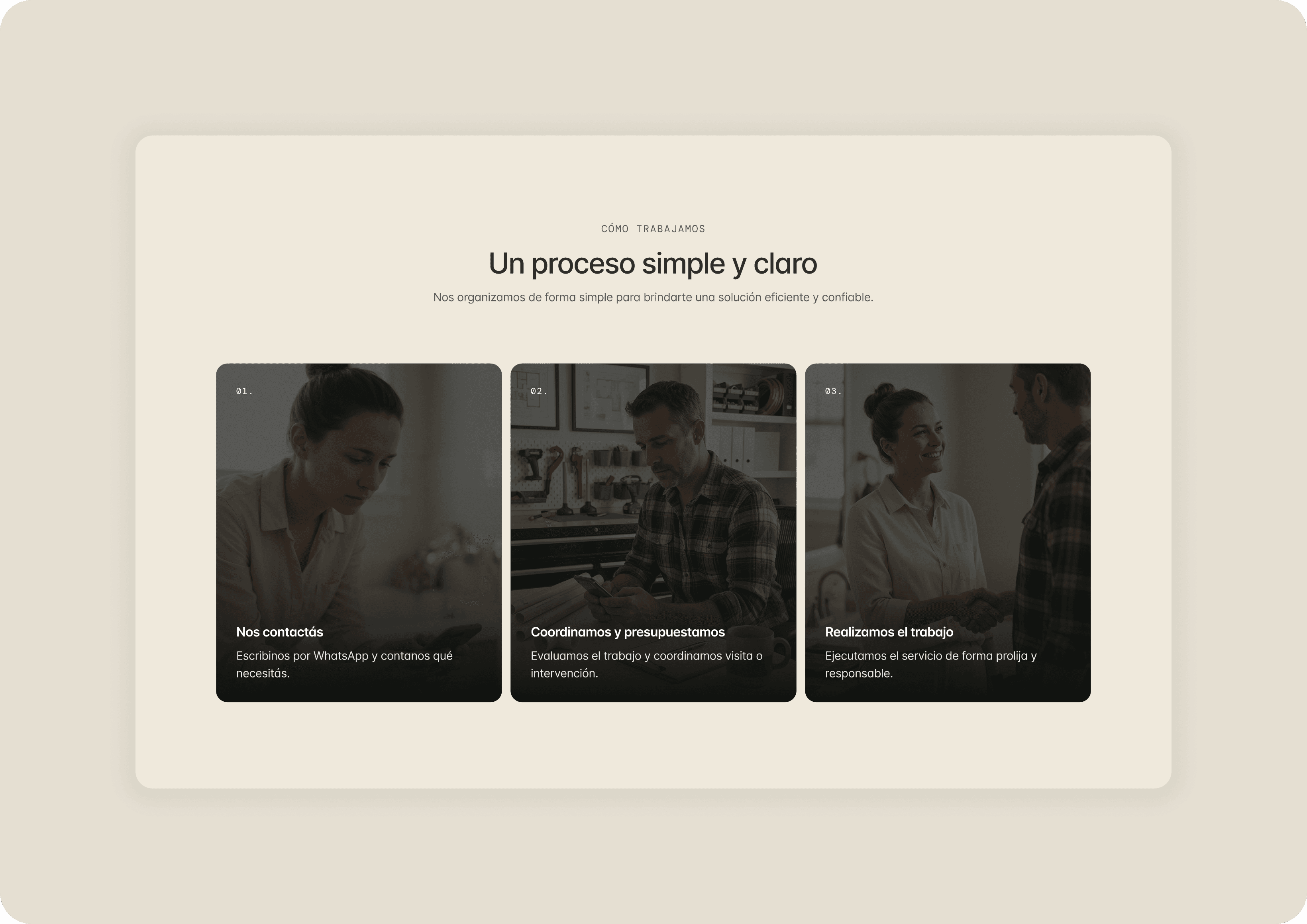
A simple three-step explanation of the service flow, created to reduce uncertainty and set clear expectations. This section helps build trust by showing a structured and transparent process. (All images were made with AI)
Conclusion / What I Learned
I learned that early-stage validation often benefits more from focus than from completeness. Designing this landing highlighted how careful prioritization and clear hierarchy can communicate quality and confidence, even without metrics, testimonials, or complex interactions.
Trust can be designed, even without metrics
Constraints often clarify priorities rather than limit solutions
A landing page can function as a meaningful product touchpoint, not just a marketing asset