01
Digital Asset Management Platform
Custom DAM platform for Sullair, designed to centralize internal files and bring clarity, control, and structure to complex asset management.
Client:
Sullair Argentina
Role:
UX/UI Designer
Team:
PM, Developers, Business
Duration:
12 weeks
Project Overview
This project involved designing a custom Digital Asset Management (DAM) platform tailored to Sullair’s internal teams. The platform was intended to centralize and control all company assets across marketing, sales, and other internal areas.
Before the DAM, Sullair relied on Google Drive to manage files, which resulted in duplicated versions, inconsistent organization, and limited control over access and permissions. While external client access was considered, the primary focus was internal usage and governance.
The Challenge
The main challenge was designing a system capable of handling complex, granular permissions without making the experience overwhelming or frustrating for users.
Initially, the idea was to standardize access through predefined user profiles, where permissions would be inherited automatically. However, due to client requirements, the platform needed to support file-level permissions, significantly increasing complexity.
Another key challenge was designing clear and scalable filtering mechanisms, allowing users to quickly find assets across a large and growing library.
Objective
The primary goal was to centralize all digital assets into a single platform, providing full control over files, access, and activity, while enabling teams to work with confidence and clarity.
Secondary goals included:
Supporting multiple internal teams with different needs
Ensuring scalability for future growth
Providing visibility and control over asset usage
My Role
I worked in a hybrid UI / Product Design role.
I initially joined the project focusing on UI execution, designing screens based on predefined user stories. As the project evolved, I became actively involved in defining new flows from scratch, especially around permissions and file management.
I collaborated closely with:
Product Managers
Developers
The research team
Internal stakeholders
This collaboration required constant iteration and alignment to balance user needs, technical constraints, and business requirements.
Process
The project followed a structured but realistic process:
The research team conducted a workshop with stakeholders to better understand business needs and expectations
A benchmark analysis of similar DAM platforms was performed
Stakeholder interviews helped validate assumptions
Based on these insights, user stories were created
The design moved from wireframes to high-fidelity screens, with multiple iterations along the way
Decisions were continuously validated with the client, especially as requirements evolved.
Solution
The final product is a Google Drive–like DAM platform, customized to Sullair’s operational needs.
Key features include:
Centralized file management
Granular permission control (including file-level permissions)
Advanced filtering and search
The ability to create individual collections
Activity visibility for users with administrative roles
The design prioritizes clarity, structure, and flexibility, even within a complex permission system.
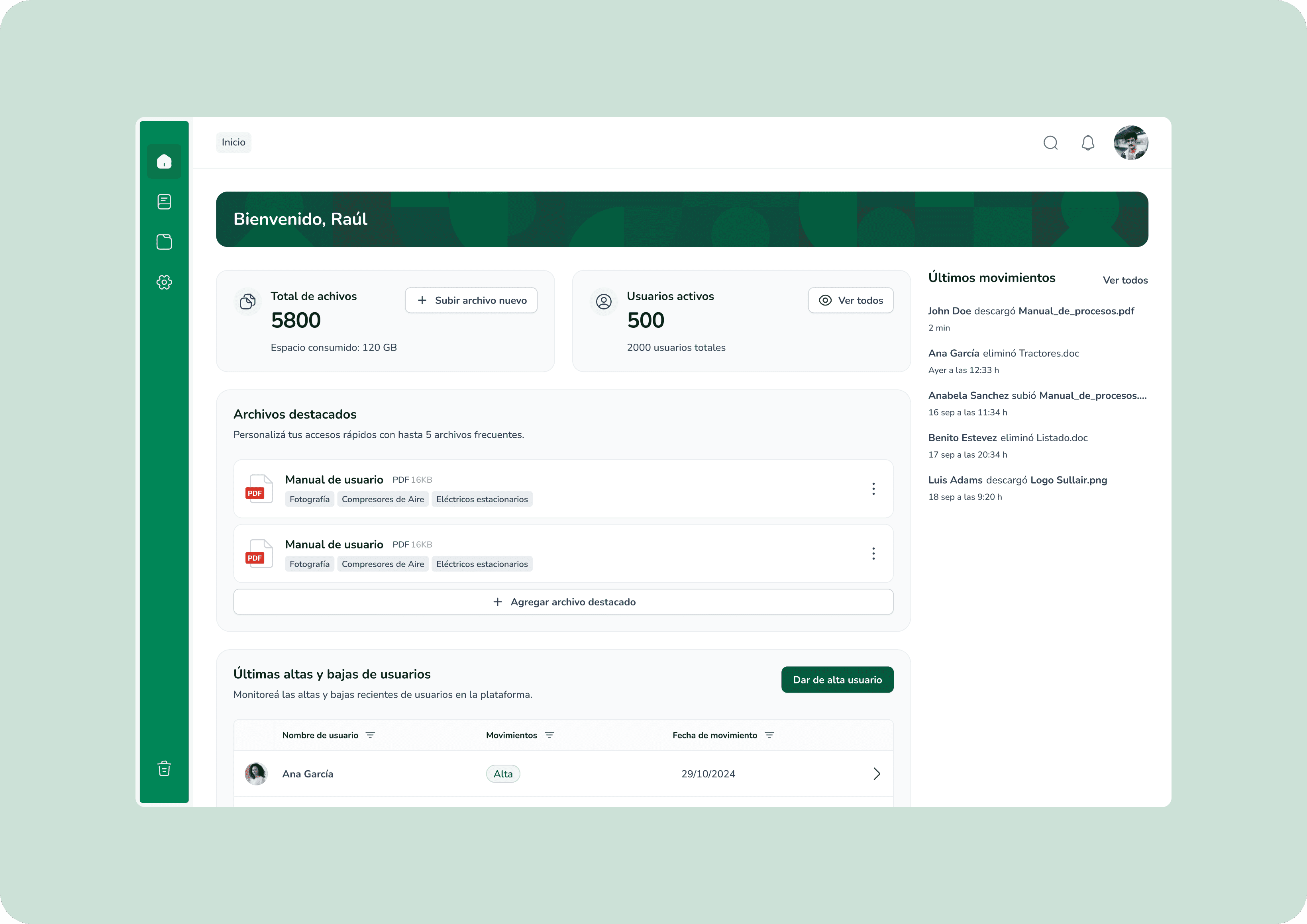
Dashboard Overview of the platform’s activity, highlighting key metrics, recent actions, and quick access to frequently used files.
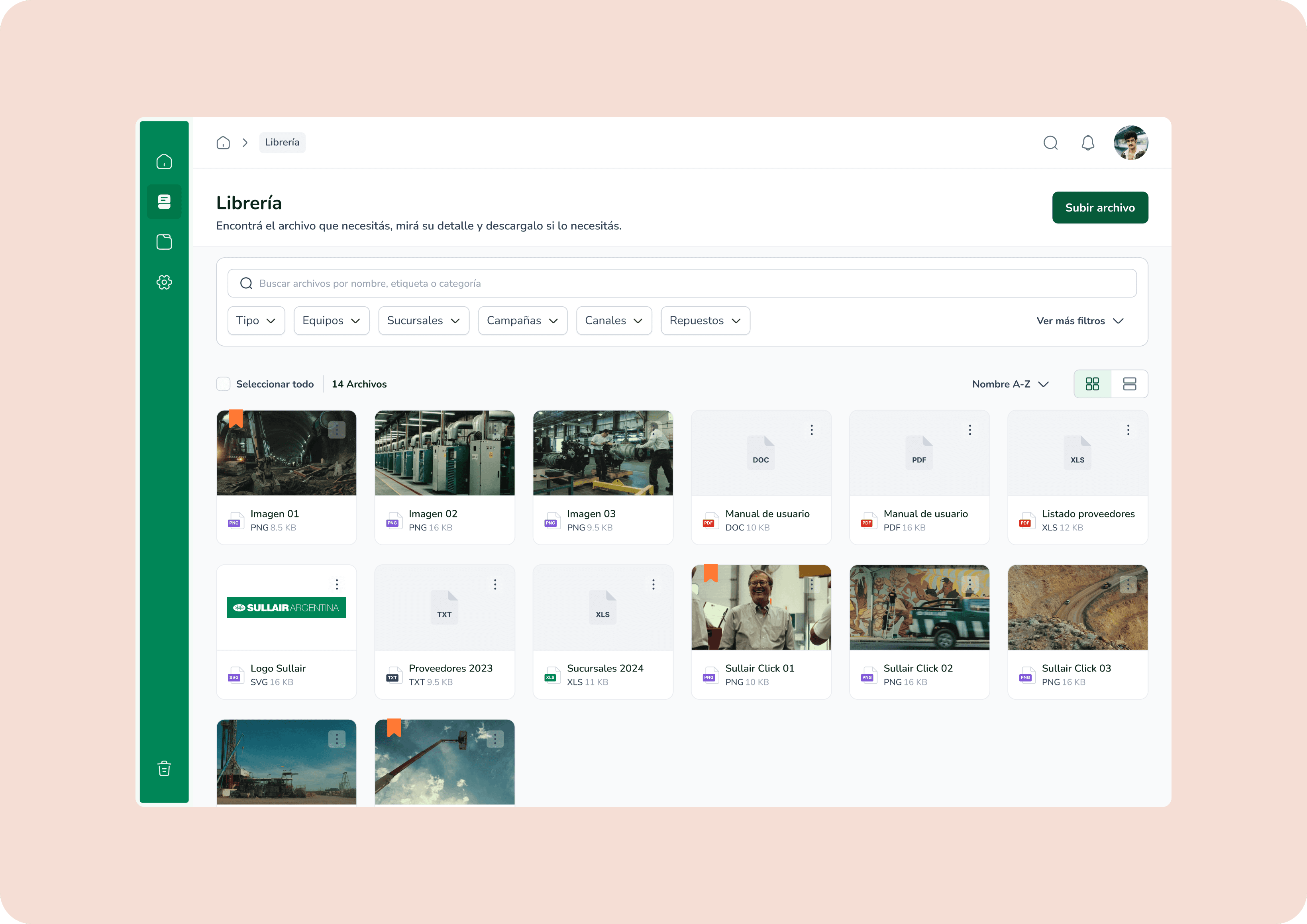
Library Centralized file library with flexible filters and multiple views, designed to help users quickly find and manage large volumes of assets.
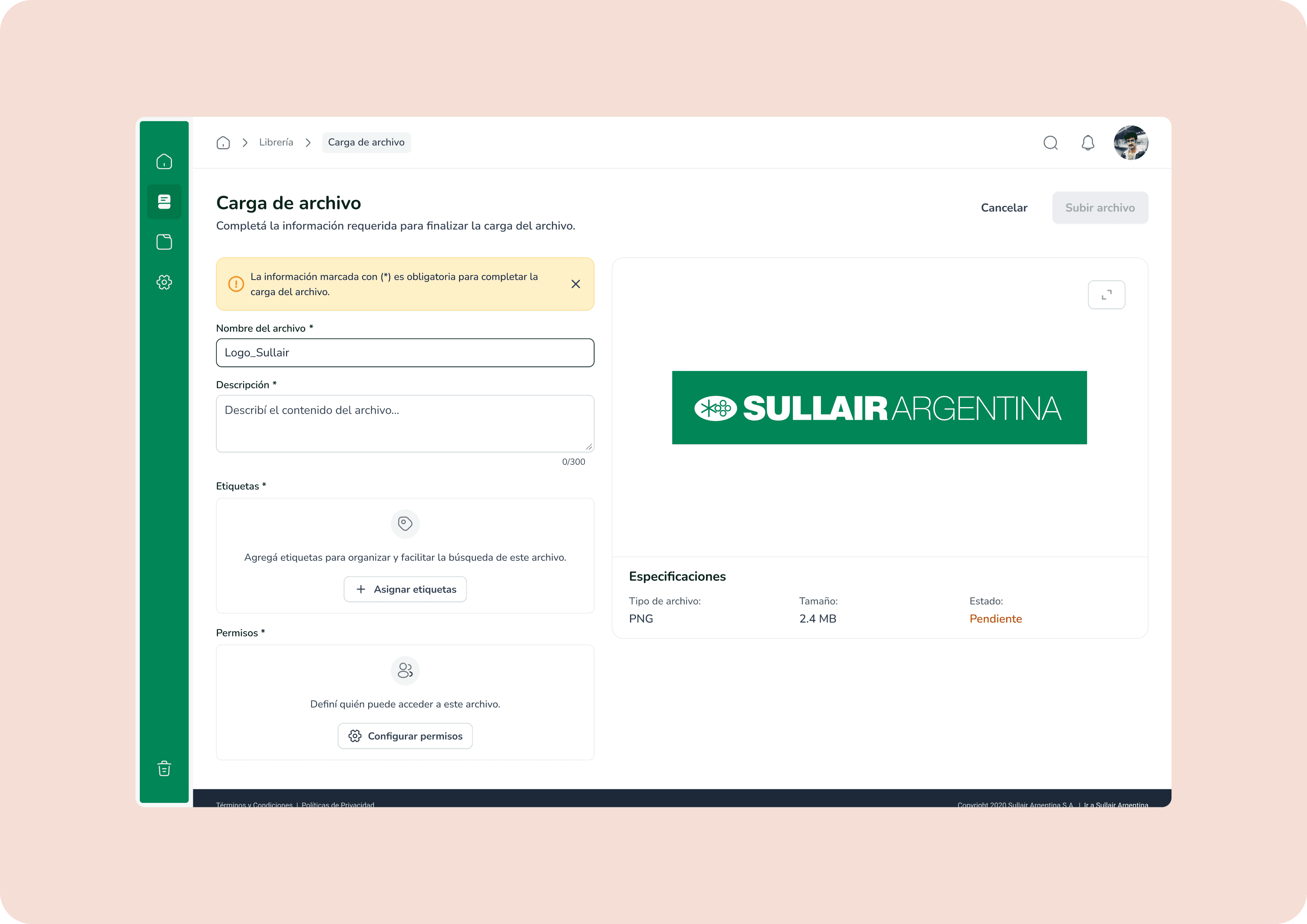
File upload & permissions Upload flow focused on clarity and control, allowing users to define metadata, tags, and granular permissions at file level.
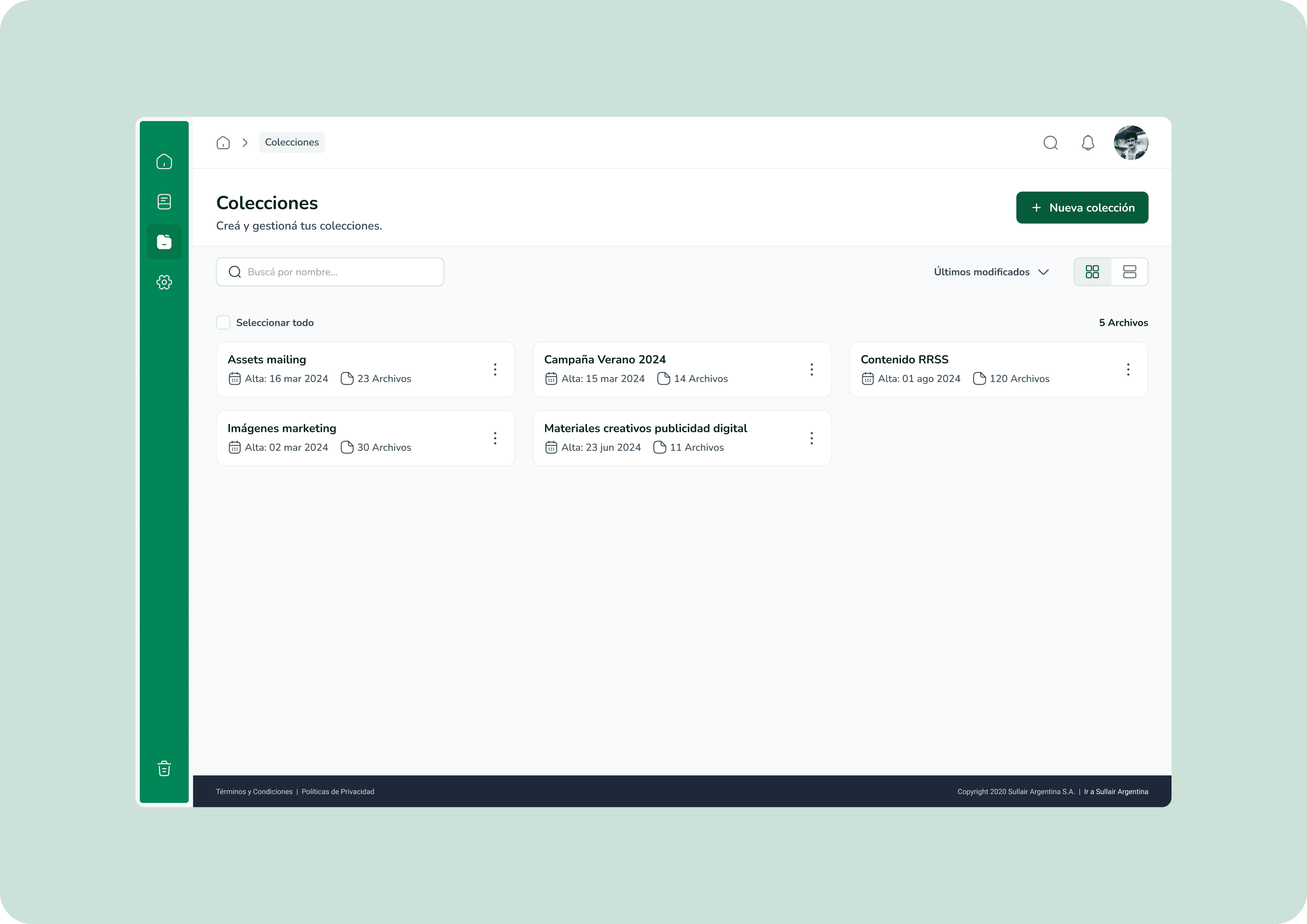
Collections Custom collections to group and organize assets by campaign, team, or use case, making content easier to reuse and share internally.
Results
The platform is currently in use internally.
While there are no quantitative metrics available yet, the client expressed satisfaction with the final product. More importantly, the DAM provided Sullair with peace of mind: all assets are now centralized, controlled, and monitored within a single system.
The product is still evolving, but it laid a solid foundation for future improvements and scalability.